


 |
| First A-Bomb 1945 New Mexico -USA |
When the first Atomic bomb was exploded at White Sands, New Mexico in 1945 - the scientists there had previously calculated a 3 in 1,000,000 chance that it would destroy the entire solar system. They went ahead absolutely recklessly anyway and exploded it. Since they were still here afterwards they decided to see if bigger ones might do the job...
The reason is deadly serious about how even 1 bomb could destroy the solar system is this. The sun is NOT an atomic reaction, nor is it a thermonuclear reaction. It is simple hydrogen under gravitational collapse. It is so large that it sends both light and plasma (which is composed of super heated extremely thin to the maximum: hydrogen) throughout the entire solar system. That plasma is the solar wind. The scientists at White Sands understood that an atomic blast could act as a trigger to ignite the solar wind in a thermonuclear reaction throughout the entire solar system and incinerate it all. No one knows what could have happened when all of the methane (which is a very large constituent of the outer planets past Mars) in the solar system could have been ignited by the incinerating fire. The reason it normally doesn't do anything is that it is extremely cold. Normal solar wind will not set it off. It is not heat alone, for the solar wind is hot, but thin, but an atomic fission reaction that will cause the hydrogen to become a thermonuclear reaction - a monstrously huge explosion. They took the chance anyway.
At the heart of every hydrogen bomb is an atomic bomb and that is what makes for a thermonuclear reaction and explosion. A hydrogen bomb would be more prone to setting off the solar wind since it has ignited hydrogen as part of its reaction already.
The earth's crust has a great deal of methane in it and it is not cold, but hot enough to produce the reaction through layers of the earth's crust that becomes oil, gas and coal in an ongoing abiotic chemical reaction based on heat (which is no where near the temperature of the much thinner solar wind).
It is the earth's very thick atmosphere and the ozone layer that blocks the solar wind and the extreme radiation of outer space from hurting the earth.
However, not content with endangering all life on earth and the very existence of the solar system, with the first atomic explosion, the scientists driven by their military masters did two things next which were even more insane.
They developed the Hydrogen bomb.
They set off nuclear explosions, by missile, in the lower reaches of outer space/higher atmosphere right where the ozone layer is. That is why there are holes in the ozone layer. There of course was even a greater chance of what had first been rightfully feared, that the solar system would be incinerated...
Enter star wars... Only God knows what will happen.
The whole nuclear program in it's initial and all phases was guided by the cabala of the Jews. Many of the scientists and theoreticians were Jews and involved in cabala. Cabala is from Satan who seeks the destruction of mankind at all times and can never be placated - that is a foolish thought. Einstein is included and he was an awful excuse for a mathematician and a thief.
Enrico Fermi, a Catholic - lived 1901 -1954, was the foremost expert in radioactivity. He was involved in the nuclear research that brought forth the Atomic bomb. It was known to be a monocatalyst reaction. They simply pragmatically backed into it until they got it to work. It was Fermi who said concerning radioactivity, that the elements that are connected with it have degraded for so long that no one can know what it really is or does.
To be world a Superpower you have to be reckless enough to have developed a Hydrogen bomb, see below...
 1954 United States hydrogen bomb United States Bikini Atoll - Castle Bravo 15 megatons  1961 Russian AN602 hydrogen bomb - Tsar Bomba 50 -58 megatons  1967 largest (publicy known of China's bombs) Chinese hydrogen bomb - 3.3 megatons  |
| The World pinioned between the Triad of the three Nuclear Superpowers of the United States, Russia and China |
Tech_Journal: Triad Revisited – A Brief Look « BellesHeures's Weblog
Triad Revisited – A Brief Look
A great number of brave and honest Police and Judiciary, which is always the rule, have stood against the following. May they continue to do that and and may all of us support them.
The Triad is Russia, China and the United States until Israel replaces the United States, then it is Russia, China and Israel – then there were two, Russia and Israel and then there was one: ISRAEL THE HOME OF THE DAJJAL, ANTICHRIST – that last move is the real reason that Yamantau exists
The idea that Britain and France and the United States and Russia and the League of Nations had any right to divide up the Ottoman Empire in any fashion because of a War started in Europe among Europeans is absurd. That this war, World War I, which the Europeans dragged the Ottoman Empire into via the slaving colonialization of the region by Europeans (especially Oil grabs and “Emirate” creation beginning in 1892) and a specious European “alliance” forced on the Ottomans, had any lawful bearing on the lawful dominion of Arabs over the region is as ridiculous as is any idea that the European troops, or any other, had any business carrying their vile internecine war into the region for any reason. World War I was financed on both European sides by Rothschild and other Zionist Judaist Bankers for the specific purpose of invading the Middle East and unlawfully pillaging the Holy Land of Christ belonging to the Christian and Muslim Arab people and steal it from them. This is being carried forth by the Triad of superpowers, The United States and Russia
Saturday, 8 January 2011
Defense Intelligence Agency
The DIA, Defense Intelligence Agency (formed 1961), is part of the Intelligence Linkups that are part of the infrastructure in which is embedded the answer to the Cuban Missile Crisis (1962). That crisis was staged by the Illuminati New World Order and gave the reason (brinksmanship of World War III) for a permanent link up of the Defense Computers of the United States and Russia United States of America and Russia Israel
Even the Central Banks don’t have ultimate power, they only have the power delegated to them by those who control these Nuclear National Military Infrastructures.
All Corporations and Industry, as well as the Banks, take their orders from these unseen International Militarist Power Brokers. Even the Intelligence Agencies of various countries, including the Triad, are permeated by these shadow dwellers.
_______________
The rest of the major linkups of the big three are here:
See:
The Justice of God: Al Debaran - Ancient Egyptian Banking The ancient money source of the Masonic Lodges.
The above Triad in the article at top is the political Triad of the 20th Century staged Cold War. See: The Justice of God: Putin and Communism and Zionism. The below Triads are the politico-religious Triads of Mesopotamian, Babylonian, Egyptian, Eurasian Houses of the Dragon, apostate Jewry, apostate Vatican Satanic attempt to wrest control of the world from God and rule it themselves - all instigated by Satan.
Traditional Catholic Prayers: Gog and Magog of the Evil Mountain of the North, Yamantau

YAMANTAU MOUNTAIN, RUSSIA - EVIL MOUNTAIN IN KURGAN RELATED LANGUAGE, WHICH LANGUAGE IS PRESENT IN THE AREA OF KHAZAKHSTAN AS WELL
IN OTHER WORDS IN THE WHOLE REGION OF THE MONGOL-TATAR TURKIC KURGAN KHAZAKH "NORTH" COUNTRY THIS IS WHERE EVIL DWELLS UNTIL THE END OF TIME - THE TERM "NORTH" HERE IS FROM OLD TESTAMENT PROPHETS CONCERNING THIS AND IS CARRIED OVER INTO THE TALMUDIC COMMENTARIES OF THE JUDAISTS.
St. Jerome about two centuries before Muhammad (pbuh) makes reference about this concerning Gog and Magog attacking the world and the Church in particular at the end of time. Islam also preserves the same tradition. This is related to Mt. Damavand in Iran and the eight petaled lotus of the Sufis and the Evil god of the Buddhists that dwells beneath the earth, which is actually the base for all Mahayana Buddhism, including especially the triple dragon god at the center of Buddhism (Dainichi Nyorai in Japanese, which is the Sun god same as in the Thule cult of Hitler and the esoteric magical cult of Hassan al Banna in the Middle East - see: God and His Messiah Jesus Christ our Lord - our right and duty to witness to Him: Omar Khayyam: Surrendering Islam). This tells us what Gorbachev was doing in 1984 when he summoned all religions to Moscow to celebrate before him in typical Communist Sergei Bulgakov/Gramscian Pantheistic manipulation of religion - and that two years before his puppet in the Vatican, Antipope John Paul II, did the same at the Assisi gatherings beginning in 1986 - the Assisi gatherings boasted of the attendance of 'Drozdov' - "Blackbird," the secret KGB operative name of Moscow Orthodox Church Patriarch Alexus II.
From Link: Cabala - Qabalah, Freemasonry, the Tijaniyah Order, the Muslim Brotherhood, Al Qaeda, and Sufism
And Qabalah continues in it’s Devil’s work. Note this concerning the below, in Islam, freemasonry and all connected to it, is considered heresy and not part of confession of Allah. Muslims call freemasonry a "hawk" which means exactly that it is heresy and wrong. Traditional Catholics agree with Muslims on this. Both Catholics and Muslims worship the true God. In the below, the various movements are shown that were used as the base for the Sabatae Zvi Frankists of the Donmeh (who subverted Turkey and caused the genocide against the Armenian Christians). The Sabatae Zvi Frankists of the Donmeh are, with the Gnostic O.T.O., a huge part of the Freemasonic influence that utterly controls the Zionist Vatican. The Sabatae Zvi Frankists of the Donmeh are the religious core and base for all Likkud and all other Talmudic Zionism in Occupied Palestine (falsely called "Israel") and throughout the world. This Zionism of the Sabatae Zvi Frankists of the Donmeh is the prime mover behind the movements leading to the Kurdish Peshmergas' attacks on the Iraqi East Assyrian Churches and the Iranian Shi'ite militias attacks in Iraq and every other assassin horror in the region. Tikun Olam is the base of Cabala and the base of the Satanic Jew Zionist Cabalistic Talmudism.
Note: Sufism itself is not a heresy in Islam, but there is heretical teaching that calls itself Sufism that Islam does condemn, and that is the kind of false Sufism used by the Frankist Donmeh.
___________________________________________
Qabalah, Freemasonry, the Tijaniyah Order, the Muslim Brotherhood, Al Qaeda, and Sufism
The Secret Doctrine of the Assassins
An Occult Religion behind an Islamist fascade
The dead hand switch at Yamantau has certainly been protected from Israel setting it off as a Samson option. Now only Iran and Syria and south-eastern Europe are in the major danger from the insane ghetto dwellers in IsraHell. But Yamantau may yet be a new Stalin's counter attack against a new Trotsky. Yamantau is still OFFENSIVELY armed to the Thermo-Nuclear Intercontinental Ballistic Missile teeth. Just like Stalin, the cold eyed Asiatic Jew, bested the Western wild eyed Magus Jew Trotsky - this may be Putin-Gorbachev versus Netanyahu-Kissinger in a final show down that could destroy the world.
miko's blog: Israel's Nuclear Weapons Program

Which leads to this in Russia. Or did it come from an earlier version of this? See Yamantau following.

Yamantau Survivor's Quarters when Israel sets off the Samson Option?
(Notice the strangely Freemasonic number 33 here. Why does it look so Rothschild like?)

You didn't think the signs would be in English or Japanese or French did you?

Aerial Photo Map showing underground Yamantau facilities.

Underground Yamantau facilities.

Yamantau Facilities.
Yamantau - Evil Mountain

An Area 51 in Russia? Some people think so and their suspicions are shared by the US Congress. Testamony was taken on Congressional suspicions of Russian complex in Yamantau Mountain, circa 1997, and can be checked with the Congressional Record for that session.
A Huge Anthill?
[www.fas.org] -- Starting in the Brezhnev period, Russia has been pursuing construction of a massive underground facility at Yamantau Mountain and the city of Mezhgorye (formerly the settlements of Beloretsk-15 and Beloretsk-16). Russia's 1997 federal budget lists the project as a closed territory containing installations of the Ministry of Defense.
On April 16, 1996, the New York Times reported on a mysterious military base being constructed in Russia:
"In a secret project reminiscent of the chilliest days of the Cold War, Russia is building a mammoth underground military complex in the Ural Mountains, Western officials and Russian witnesses say.
"Hidden inside Yamantau mountain in the Beloretsk area of the southern Urals, the project involved the creation of a huge complex, served by a railroad, a highway, and thousands of workers."
The complex, being built inside Yamantau mountain by tens of thousands of workers, covers an area the size of the Washington area inside the Beltway.
There are reportedly provisions for living inside the man-made caves. There is an underground warehouse for food and clothing, a shelter for the Russian national leadership in case of nulcear war, and rumors that the Yamantau Mountain project was associated with the so-called 'Dead Hand' nuclear retaliatory command and control system for strategic missiles.
[Full article plus map].

Some U.S. analysts believe the secret underground complex beneath Yamantau Mountain betrays a lingering belief among top Russian leaders that they must continue to prepare to fight and win a nuclear war. Russians say they still fear the U.S.
Priors on the Record
It is now known that the Soviet Union used secret underground bases in Eastern Europe to conceal nuclear missiles at the end of the Cold War, as an integral part of its nuclear war-fighting strategy. In all, some 73 SS-23 missiles, packing a nuclear punch 365 times the bomb that detonated over Hiroshima, were hidden by the Soviets in violation of the INF Treaty, which went into force in June 1988.
If war had broken out those missiles would have given the Soviets an overwhelming strategic advantage against the United States, allowing them to decimate NATO forces in Europe in a surprise attack. The last of these missiles will be destroyed by the government of Slovakia, under a grant from the United States.
Today, Russia may be conducting nuclear deception on a far vaster scale beneath Yamantau Mountain, where it has dug out a gigantic underground military complex designed to withstand a sustained nuclear assault. A U.S. intelligence source was quoted as saying that the Yamantau complex is but one of some 200 secret deep underground nuclear war-fighting sites in Russia, many of which have been significantly upgraded over the past six years at a cost of billions of dollars.

This declassified Defense Intelligence Agency map [right] shows the relative location of the underground Yamantau Mountain complex. Since the end of the Cold War in 1991, U.S. intelligence sources believe the Russian government has pumped more than$6 billion into Yamantau alone, to construct a sprawling underground complex that spans some 400 square miles.
In 1998, in a rare public comment, then-Commander of the U.S. Strategic Command (STRATCOM) Gen. Eugene Habinger, called Yamantau
"a very large complex -- we estimate that it has millions of square feet available for underground facilities. We don't have a clue as to what they're doing there."
It is believed to be large enough to house 60,000 persons, with a special air filtration system designed to withstand a nuclear, chemical or biological attack. Enough food and water is believed to be stored at the site to sustain the entire underground population for months on end."The only potential use for this site is post-nuclear war..." --- Rep. Roscoe Bartlett
Bartlett is one of the handful of members of Congress who have closely followed the Yamantau project.
The Yamantau Mountain complex is located close to one of Russia's remaining nuclear weapons labs, Chelyabinsk-70, giving rise to speculation it could house either a nuclear warhead storage site, a missile base, a secret nuclear weapons production center, a directed energy laboratory or a buried command post. Whatever it is, Yamantau was designed to survive a nuclear war.
In response to repeated U.S. inquiries, the Russian government has provided no fewer than 12 separate and contradictory explanations for the site, none of them believed to be credible.
A 1997 Congressional Research Service report said that the vast sums invested to build the Yamantau Mountain complex "provide evidence of excessive military modernization in Russia." Russia is pouring money into this and other underground nuclear sites at the same time U.S. taxpayers have provided billions of dollars in aid to Russia to help dismantle nuclear warheads taken off line as a result of START I and START II."Yamantau Mountain is the largest nuclear-secure project in the world... They have very large train tracks running in and out of it, with enormous rooms carved inside the mountain. It has been built to resist a half dozen direct nuclear hits, one after the other in a direct hole. It's very disquieting that the Russians are doing this when they don't have $200 million to build the service module on the international space station and can't pay housing for their own military people," ---Rep. Bartlett.
The Russians have constructed two entire cities over the site, known as Beloretsk 15 & 16, which are closed to the public, each with 30,000 workers. No foreigner has ever set foot near the site. A U.S. military attache stationed in Moscow was turned back when he attempted to visit the region a few years ago.
Neither the Central Intelligence Agency nor the Defense Intelligence Agency will comment on what the Russians are doing at Yamantau Mountain.
"There's not a lot we could say without venturing into the classified realm," CIA spokesman Mike Mansfield said. "It's hard to discuss it with any specificity."

This U.S. satellite photograph of the Yamantau Mountain [left] region was taken on Oct. 16, 1997. Clearly recognizable signs of excavation can be seen at the areas marked Yamantau Mountain and Mezhgorye. Two above-ground support cities, each housing 30,000 workers, are located at Beloretsk and Tirlyanskiy.
The very little that is known publicly about the site comes from Soviet-era intelligence officers, who defected to Great Britain and the United States. In public testimony before a House Armed Services Subcommittee last October, KGB defector Col. Oleg Gordievsky said the KGB had maintained a separate, top-secret organization, known as Directorate 15, to build and maintain a network of underground command bunkers for the Soviet leadership -- including the vast site beneath Yamantau Mountain.
"And what is interesting was that President Yeltsin and Russia's new democratic leaders are using those facilities, and the same service is still running the same facility, like it was 10, 15 years ago." --- Col. Oleg Gordievsky
Yamantau Mountain is so secret that only a handful of Russian government officials knows about it, says Rep. Curt Weldon, R-Pa., who speaks Russian and travels frequently to Russia, chairing a congressional working group that discusses strategic issues with counterparts from the Russian Duma.
"I ask the Russians about it every time I meet with them... We've never had a straight answer."
Weldon got interested in Yamantau Mountain in 1995 when he saw a public report suggesting it was a vast mining project.
"I went to Moscow and spoke with the deputy interior minister who was in charge of mining," Weldon says. "I asked him if there was any mining activity there. He just shook his head and said he had never heard of it. So I mentioned the other name the Russians use for it: Mezhgorye. He said he hadn't heard of that either. Then he sent an aide out to check. Twenty minutes later, the aide came back, visibly shaken. He said they couldn't say anything about it."
Weldon also met with Andrei Kokoshkin, a former deputy defense minister, in charge of President Yeltsin's National Security Council.
"Kokoshkin called it a public works project, and said there was nothing to worry about, since the Defense Ministry had no involvement in it. So I brought out a copy of the Defense Ministry's budget -- it's only a few pages long -- and showed him the line item for Mezhgorye. He smiled and said it must be for bridges, roads and schools. When I then asked if I could see it, he said that could only be arranged through Yeltsin. The site was controlled directly by the president."
Weldon then tried sending a 3-page letter to Yeltsin in Russian.
"I told him all the things I was trying to do to foster better U.S.-Russia understanding, but said that I couldn't help if they couldn't clear up something as important as this. He never replied."
Where's the Money Coming From?
The cause for concern is that the US is currently sending hundreds of millions of dollars to Russia, supposedly to help that country dismantle old nuclear weapons. Meanwhile, the Russian parliament has been complaining that it cannot pay $250 million in back wages owed to its workers at the same time that it is spending money to comply with new strategic arms reduction treaties.
Aviation Week and Space Technology reported that "It seems the nearly $30 billion a year spent on intelligence hasn't answered the question of what the Russians are up to at Yamantau Mountain in the Urals. The huge underground complex being built there has been the object of U.S. interest since 1992. 'We don't know exactly what it is,' says Ashton Carter, the Pentagon's international security mogul. The facility is not operational, and the Russians have offered 'nonspecific reassurances' that it poses no threat to the U.S."
The following is an excerpt from an interview between Chris Ruddy and Col. Stanislav Lunev, a Russian military intelligence officer who defected in 1992.†Col. Stanislav Lunev is the highest-ranking military intelligence officer ever to have defected from Russia.
You ask about Yamantau Mountain.†Well, this is a huge underground city, which could be used in time when many Russian cities are destroyed, but the military and political elite will survive and live until our planet will try to restore itself.
U.S. law states that the Administration must certify to Congress that any money sent to Russia is used to disarm its nuclear weapons. However, is that the case? If the Russian parliament is complaining of a shortage of funds for nuclear disarmament, then how can Russia afford to build the Yamantau complex?
Could American funds be subsidizing a Russian weapons factory? A "doomsday" shelter? Or possibly something even more sinister? We'd like to hear YOUR opinion. Write tomyristicin@hotmail.com.
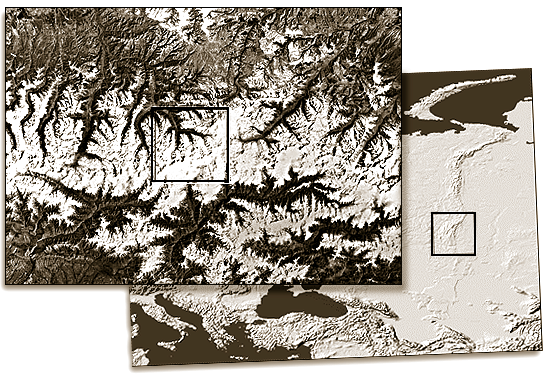
The Ural Mountains, which are also called the Stone Belt, extend for 2500 km from the hot Kazakh steppes to the frozen coast of the Arctic Ocean. Geographers divide the Urals into five regions: South, Middle, North, Subarctic and Arctic Urals. The widest part of the Urals is called the South Urals, and comprises dozens of parallel ridges, bounded in the north and in the south by the valleys of Ufalei River and Ural River respectively. Steppe and forest-steppe landscapes are typical of the foothills in this part of the Urals. Higher in the mountains, the hillsides are covered with mixed forests and the highest peaks, like islands, emerge among the green ocean of forest. The highest mountains of the South Urals - Yamantau (1640 m) and Bolshoi Ieremele (1582 m) - are located in the western row of ridges.
http://viewzone2.com/yamantau.html
See this link.
Triad Revisited – A Brief Look
A great number of brave and honest Police and Judiciary, which is always the rule, have stood against the following. May they continue to do that and and may all of us support them.
The Triad is Russia, China and the United States until Israel replaces the United States, then it is Russia, China and Israel – then there were two, Russia and Israel and then there was one: ISRAEL THE HOME OF THE DAJJAL, ANTICHRIST – that last move is the real reason that Yamantau exists
The idea that Britain and France and the United States and Russia and the League of Nations had any right to divide up the Ottoman Empire in any fashion because of a War started in Europe among Europeans is absurd. That this war, World War I, which the Europeans dragged the Ottoman Empire into via the slaving colonialization of the region by Europeans (especially Oil grabs and “Emirate” creation beginning in 1892) and a specious European “alliance” forced on the Ottomans, had any lawful bearing on the lawful dominion of Arabs over the region is as ridiculous as is any idea that the European troops, or any other, had any business carrying their vile internecine war into the region for any reason. World War I was financed on both European sides by Rothschild and other Zionist Judaist Bankers for the specific purpose of invading the Middle East and unlawfully pillaging the Holy Land of Christ belonging to the Christian and Muslim Arab people and steal it from them. This is being carried forth by the Triad of superpowers, The United States and Russia
Saturday, 8 January 2011
Defense Intelligence Agency
The DIA, Defense Intelligence Agency (formed 1961), is part of the Intelligence Linkups that are part of the infrastructure in which is embedded the answer to the Cuban Missile Crisis (1962). That crisis was staged by the Illuminati New World Order and gave the reason (brinksmanship of World War III) for a permanent link up of the Defense Computers of the United Statesand Russia United States of America and Russia Israel
Even the Central Banks don’t have ultimate power, they only have the power delegated to them by those who control these Nuclear National Military Infrastructures.
All Corporations and Industry, as well as the Banks, take their orders from these unseen International Militarist Power Brokers. Even the Intelligence Agencies of various countries, including the Triad, are permeated by these shadow dwellers.
_______________
The rest of the major linkups of the big three are here:
See:
The Justice of God: Al Debaran - Ancient Egyptian Banking The ancient money source of the Masonic Lodges.
The above Triad in the article at top is the political Triad of the 20th Century staged Cold War. See: The Justice of God: Putin and Communism and Zionism. The below Triads are the politico-religious Triads of Mesopotamian, Babylonian, Egyptian, Eurasian Houses of the Dragon, apostate Jewry, apostate Vatican Satanic attempt to wrest control of the world from God and rule it themselves - all instigated by Satan.
Type 094 Jin-class Ballistic Missile Submarine
Type 094 Jin-class Ballistic Missile Submarine
A new design (type 094) has been planned since the late 1980s. Possibly incorporating some Russian technology, the Type 094 was expected to be a dramatic improvement over the sole Xia class SSBN, with improved quieting and sensor systems, and a more reliable propulsion system. Other improvements in sonar, propulsion, training, and the application of quieting techniques will contribute to a significant improvement in the capabilities of China's submarine fleet.
Type 094 Jin-class Nomenclature
The collapse of the Han dynasty in A.D. 220 was followed by nearly four centuries of rule by warlords. The age of civil wars and disunity began with the era of the Three Kingdoms (Wei, Shu, and Wu, which had overlapping reigns during the period A.D. 220-80). In later times, fiction and drama greatly romanticized the reputed chivalry of this period. Unity was restored briefly in the early years of the Jin dynasty (A.D. 265-420), but the Jin could not long contain the invasions of the nomadic peoples. In A.D. 317 the Jin court was forced to flee from Luoyang and reestablished itself at Nanjing to the south. To fend off barbarian intrusion, the fortification walls built by the various warring states were connected to make a 5,000- kilometer-long great wall. What is commonly referred to as the Great Wall is actually four great walls rebuilt or extended during the Western Han, Sui, Jin, and Ming periods, rather than a single, continuous wall. At its extremities, the Great Wall reaches from northeastern Heilongjiang Province to northwestern Gansu.
The Yangtze River, some 6300 km long in total, is the largest river in China and the third in the world(the Nile and the Amazon rank the first and second). The harnessing and utilization of the Yangtze River began in the Spring-Autumn and Warring Period. Many water conservancy projects for irrigation, flood control and transportation were built through ages of efforts. The well-known Jingjiang Great Dike is a product of ages of construction beginning from Spring-Autumn and Warring Period. Its history can be divided into four periods: commenced in Spring-Autumn and Warring Period and Jin Dynasty, completed various sections in Song Dynasty, came into being as a whole in Ming Dynasty, and heightened and reinforced in modern times. The Jiangsu-Zhejiang Sea Dikes, located at the mouth of the Yangtze, is about 400 km long. Its construction began at the mouth of Qiantangjiang River in East Han Dynasty, and the later expansion in East Jin Dynasty built the dikes to present Baoshan area. The whole dikes are finally formed in Tang and Song Dynasty.
The Yellow River is the second largest river in China. It is said that it had administrators special for water management as early as in the dynasties of Xia, Shang and Zhou. At that time the management of the Yellow River had become an important matter of the state. In Jin and Yuan Dynasty, the river engineering works in the lower reaches were protected together by the army and people.
Acupuncture is one discipline within the comprehensive system of Chinese medicine and healthcare. The origins of Chinese medicine are ascribed to Huang Ti, the Yellow Emperor. Huang Ti, the third of five legendary Chinese emperors, is reported to have ruled between 2696 and 2598 B.C. The Huang Ti Nei Ching or Yellow Emperor's Classic of Internal Medicine is the oldest known medical text and established the foundation for the theory and practice of all Chinese medicine. Over the centuries, the Nei Ching has undergone numerous revisions and clarifications. One of the most significant occurred during the Western Jin Dynasty (265-318 A.D.), with the publication of the first comprehensive text devoted exclusively to acupuncture and moxibustion1 for the treatment of disease and maintenance of health.
Type 094 Jin-class Design
The Type 094 is based on the same basic design as the Type 093 nuclear-powered attack submarine, utilising the same power plant. Each of the Type 094 SSBNs will mount 12 [not 16] JL-2 ballistic missiles (DF-31s) with a range of 8000 kms. When deployed, this missile will allow Chinese SSBNs to target portions of the United States for the first time from operating areas located near the Chinese coast. Equipped with the JL-2 missiles, the Type 094 SSBNs would only have to patrol just to the northeast of the Kuril Islands to hold about three-fourths of the United States at risk. The TYPE 094 SSBN, equipped with the 8,000+ km range, penetration aid-equipped JL-2 SLBM, will provide China with a modern and robust sea-based nuclear deterrent force.
On 15 October 2007 a photograph appeared on several Chinese Web sites, apparently taken from the water at a reasonably close range, that showed two of China's Jin-class ballistic-missile submarines alongside a pier at an unknown location in China. The picture, released the same day that China's Party Congress, held once every five years to choose the country's top leaders and set policy, opened in Beijing. The photograph confirms the assessment made by the US intelligence community, clearly showing the open hatches of 12 launch tubes, ending speculation that the Jin-class would carry 16 missiles.
Type 094 Jin-class Program
The overall size of the Chinese submarine force will decline as older boats are scrapped and new ones are built at a slower pace. There is unconfirmable speculation that as many as a dozen of these new boats may be eventually constructed, though other estimates suggest that 4-6 or 6-8 boats may be constructed.
Plans to deploy this class of nuclear powered SSBNs are said to have been delayed due to problems with the nuclear reactor power plants. In December 1999 it was reported that China had begun construction on the first Type 094 missile submarine, with preparations for the construction detected by US intelligence in November 1999. Several years would be required for submarine construction, and probably an additional year or two for shake-down trials of the submarine, and testing of the JL-2 from the submarine. At that time both the JL-2 and the first Type 094 were expected to be deployed around 2005 or 2006.
As of December 2000 construction of the first Type 094 had apparently been delayed, and the PLAN had yet to test-launch the JL-2. Priority had been given to the Type 093 nuclear-powered attack submarine. Although the keel of the first Type 093 had been laid, completion was not expected until after 2005.
On 02 December 2004 Bill Gertz reported that the new 094-class submarine had been launched in late July 2004. The new Type 094 was spotted by US intelligence at the Huludao shipyard, on the coast of Bohai Bay, some 250 miles northwest of Beijing. The submarine was in the early stages of being outfitted and was not yet equipped with new JL-2 submarine-launched nuclear missiles. The Pentagon report on Chinese military power released in May 2004 stated that the new Chinese missile submarine would not be operational until around 2010.
In March 2007 Seapower Magazine published an article based on information supplied by the US Office of Naval Intelligence (ONI), and subsequently obtained under the Freedom of Information Act. According to ONI, while China only built a single XIA SSBN, which is equipped with a short range (1,770+ km) SLBM, a fleet of probably five TYPE 094 SSBNs will be built in order to provide more redundancy and capacity for a near-continuous at-sea SSBN presence. Construction and sea trials of the TYPE 094 program were ongoing as of late 2006, and at that time ONI assessed that a TYPE 094 could reach Initial Operating Capability (IOC) as early as 2008.
According to the US Department of Defense's Annual Report to Congress on The Military Power of the People's Republic of China for 2010, "China continues production of its newest JIN-class (Type 094) nuclear powered ballistic missile submarine (SSBN). China may field up to five new SSBNs. One JIN class SSBN has entered service alongside two new SHANG-class (Type 093) nuclear-powered attack submarines (SSN), four older HAN-class SSNs, and China's single XIA-class SSBN." This statement is somewhat difficult to understand without further explanation, since a pair of JIN class SSBNs was visible in commercial satellite imagery as early as 2008. And the August 2009 US Office of Naval Intelligence report "The People's Liberation Army Navy: A Modern Navy With Chinese Characteristics" reported that China had three SSBNs, that is, one XIA and two JINs.
According to the US Department of Defense's Annual Report to Congress on The Military Power of the People's Republic of China for 2013, "Three JIN-class SSBNs (Type 094) are currently operational, and up to five may enter service before China proceeds to its next generation SSBN (Type 096) over the next decade. The JIN-class SSBN will carry the new JL-2 submarine launched ballistic missile with an estimated range of more than 4,000 nm." The careful reader may note the reference to the JL-2 is in the future tense, suggesting that the DOD assessment was that this new SLBM was not operationally deployed. World Warships reported that all five boats were operational as of 07 June 2012, but this is not widely supported by other sources.
China had at least four nuclear submarines class "Jin" (Project 094), capable of carrying ballistic missiles (SSBN). As reported by local media 19 January 2015, because of the high security of the project, only three such submarines were previously known.
The submarine base on Hainan Island has underwater entry and exit, so if China based the Type 094 from this Island, in-port satellite imagery could become impossible.
 |
| Jin (Type_094) Class Ballistic Missile Submarine |
JL-2 (CSS-NX-14) - China Nuclear Forces
JL-2 (CSS-NX-14)
The new JL-2 submarine-launched ballistic missile (SLBM) is the sea-based variant of the DF-31 land-mobile long-range missile. Development of these missiles was accelerated following the successful test of their common 2m-diameter solid rocket motor in late 1983. The missile is apparently roughly comparable in size and performance to the American TRIDENT C-4 long-range multiple-warhead three-stage solid fuel missile missile that is launched from submerged submarines.
The missile will reportedly carry either 3 or 4 MIRV (90kT each) or a single warhead with a yield of 250-1000 kT. Other reports suggest that each missile might be loaded with as many as six warheads. Most reports agree that the JL-2 will ahve a range of about 8,000 km, while some reports suggest that the missile will have an estimated range at least 9,000 kilometers.
Some sources suggest that China tested the JL-2 in 1999, but as of December 2000, construction of the first Type 094 had apparently been delayed, and the PLAN had yet to test-launch the JL-2.
The first at-sea launch of China's JL-2 ballistic missile in mid-January 2001 was conducted from China's Golf-class trialssubmarine. The Chinese have modified the older Russian-made submarine, based at a naval port on the north China coast, for "pop-up" tests of the JL-2. The test involves ejecting the missile out of the submarine launch tube. China carried out another pop-up test of the JL-2 in October 2001. As of early February 2002 China was preparing to conduct another test of the JL-2.
On 02 December 2004 Bill Gertz reported that China conducted tests of the JL-2 in 2002 and 2003. The Chinese suffered a setback in the JL-2 missile program when a test flight of the JL-2 missile failed in the summer of 2004. The JL-2 missile program was delayed by the test failure but is continuing to be developed.
China test-fired a new long-range, submarine-launched ballistic missile on 16 June 2005. The missile was believed to be the Ju Lang-2. The new SLBM was reportedly fired from a nuclear submarine in waters off Qingdao, with the warhead impacting in a desert in China several thousand kilometers away.
This missile was though to be designated the CSS-NX-4 by the US intelligence community, but many reports suggested that it is designated the CSS-NX-5. The U.S. Air Force National Air and Space Intelligence Center (NASIC) published “Ballistic and Cruise Missile Threat” in July 2013 settled matters by using the previously unheard of CSS-NX-14 designation.
The prospects for the deployment of this missile long remained obscure, given the protracted development effort of the associated DF-31, the initial deployment of which has slipped from 1998 to around 2003. Also worthy of note was the persisent absence of public reports of the start of construction of the Type 094 submarine that would be needed for the JL-2 missile.
On 02 December 2004 Bill Gertz finally reported that the new 094-class submarine had been launched in late July 2004. Construction of this submarine would constitutes a leading indicator for the JL-2's deployment schedule, since several years would be required for submarine construction, and probably an additional year or two for shake-down trials of the submarine, and testing of the JL-2 from the submarine.
In the 2004 edition of the US Department of Defense "Annual Report on the Military Power of the People's Republic of China" the deployment dates for two new Chinese ballistic missiles (DF-31 and JL-2) had slipped from "mid-to-late-decade" [reported in the 2003 edition] to "by the end of the decade". In May 2008 a JL-2 was successfully launched from the 031-type submarine. In early 2009, the JL-2 was successfully launched for the first time by the Type 094 submarine.
According to the US Department of Defense's Annual Report to Congress on The Military Power of the People's Republic of China for 2013, "Three JIN-class SSBNs (Type 094) are currently operational, and up to five may enter service before China proceeds to its next generation SSBN (Type 096) over the next decade. The JIN-class SSBN will carry the new JL-2 submarine launched ballistic missile with an estimated range of more than 4,000 nm." The careful reader may note the reference to the JL-2 is in the future tense, suggesting that the DOD assessment was that this new SLBM was no operationally deployed. The Julang-2 is estimated to have a range of "more than 4,000 nm" [about 7,500 km or 4,600 statute miles], which may bring Hawaii and Alaska (but not the continental United States) within reach if the missile were launched from a submarine in Chinese territorial waters. The U.S. Air Force National Air and Space Intelligence Center (NASIC) published “Ballistic and Cruise Missile Threat” in July 2013 with a map depicting JL-2 coverage as barely reaching the Aleutians, and falling well short of either Hawaii or the continental United States.
The 2013 Report To Congress Of The U.S.-China Economic And Security Review Commission reported in November 2013 that "China’s Julang-2 (JL–2) submarine-launched ballistic missile (SLBM) is expected to reach initial operational capability by late 2013. The JL–2, when mated with the PLA Navy’s JIN-class nuclear ballistic missile submarine (SSBN), will give China its first credible sea-based nuclear deterrent. The JIN SSBN/JL–2 weapon system will have a range of approximately 4,000 nautical miles (nm), allowing the PLA Navy to target the continental United States from China’s littoral waters. China has deployed three JIN SSBNs and probably will field two additional units by 2020. China also is developing its next generation SSBN, the Type 096, which likely will improve the range, mobility, stealth, and lethality of the PLA Navy’s nuclear deterrent."
Specifications
Contractor Academy of Rocket Motors Technology - ARMT
Configuration Three Stage
Length [meters] 10+
Diameter [meters] 2.0
Mass [kilograms] 20,000+
Propellant Solid
Guidance Inertial
First Flight 19
IOC 19
Deployment Type 094 SSBN
Range (km) 7,500-8,000
Re-entry Vehicle Mass (kg) 700 kg
Warhead Yield 3 or 4 MIRV @ 90 kT
1 @ 250-1000 kT
CEP (meters) 500 ??
 |
| JL 2 Missile Launch |
Inside the Ring: China tests nuclear missile for submarine launch - Washington Times
By
Bill Gertz - - Wednesday, February 18, 2015 China carried out a
flight test of its new JL-2 submarine-launched ballistic missile last
month, highlighting Beijing’s nuclear buildup of missile
submarines. The JL-2 flight test took place Jan. 23, according to
defense officials familiar with details of the test.
No
details of the test were available. China in the past has conducted
JL-2 flight tests from the Bohai Sea.
Pentagon
spokesman Lt. Col. Jeff Pool declined to comment on the test. But Lt.
Col. Pool said the JL-2 was discussed in the Pentagon’s most recent
annual report on the Chinese military as one part of the People’s
Liberation Army Navy’s “first credible long-range sea-based
nuclear deterrent.”
The
JL-2 test took place, coincidentally, on the same day that North
Korea conducted what Pentagon officials said was the first flight
test of a developmental submarine-launched ballistic missile called
the KN-11. Officials said there did not appear to be any linkage
between the two tests.
The
congressional U.S.-China Economic Security and Review Commission
stated in its latest annual report that the JL-2 is part of China’s
expanding strategic nuclear forces and appears to have reached
initial operating capability.
“The
JL-2’s range of approximately 4,598 miles gives China the ability
to conduct nuclear strikes against Alaska if launched from waters
near China; against Alaska and Hawaii if launched from waters south
of Japan; against Alaska, Hawaii and the western portion of the
continental United States if launched from waters west of Hawaii; and
against all 50 U.S. states if launched from waters east of Hawaii,”
the report said.
The
commission report said that despite uncertainty surrounding the
number of Chinese nuclear missiles and warheads, “it is clear
China’s nuclear forces over the next three to five years will
expand considerably and become more lethal and survivable with the
fielding of additional road-mobile nuclear missiles; as many as five
JIN [missile submarines], each of which can carry 12 JL-2
submarine-launched ballistic missiles; and intercontinental ballistic
missiles armed with multiple independently targetable reentry
vehicles (MIRVs).”
China’s
nationalistic state-run newspaper Global Times in 2013 published a
lengthy article that stated that nuclear JL-2 missile strikes on the
western United States would kill 5 million to 12 million people
through a combination of blasts and radioactive fallout.
The
article was later pulled from the newspaper’s website after reports
about the provocative report were published in the West.
The
Obama administration and Pentagon remained silent on the Global Times
report. When asked about the report in November 2013, Chief of Naval
Operations Adm. Jonathan Greenert appeared to dismiss the Chinese
submarine missile nuclear threat as not credible.
China
was to have carried out the first missile submarine patrols with
nuclear-armed JL-2 missiles by the end of last year.
However,
Defense Intelligence Agency Director Marine Corps Lt. Gen. Vincent
Stewart told the House Armed Services Committee Feb. 3 that the first
missile submarine patrols are expected this year.
Last
year, China on two occasions deployed submarines to the Indian Ocean
in what Lt. Gen. Stewart said were part of plans for boosting Chinese
power projection.
“China
continues production of JIN-class nuclear-powered ballistic missile
submarines and submarine-launched ballistic missiles,” the general
said.
 |
| Hawaii to mainland USA (New York City) is 4,834 miles. Hawaii to Los Angeles is 2,479 miles. |
The commission report said that despite uncertainty surrounding the number of Chinese nuclear missiles and warheads, “it is clear China’s nuclear forces over the next three to five years will expand considerably and become more lethal and survivable with the fielding of additional road-mobile nuclear missiles; as many as five JIN [missile submarines], each of which can carry 12 JL-2 submarine-launched ballistic missiles; and intercontinental ballistic missiles armed with multiple independently targetable reentry vehicles (MIRVs).”
China’s nationalistic state-run newspaper Global Times in 2013 published a lengthy article that stated that nuclear JL-2 missile strikes on the western United States would kill 5 million to 12 million people through a combination of blasts and radioactive fallout.
The article was later pulled from the newspaper’s website after reports about the provocative report were published in the West.
The Obama administration and Pentagon remained silent on the Global Times report. When asked about the report in November 2013, Chief of Naval Operations Adm. Jonathan Greenert appeared to dismiss the Chinese submarine missile nuclear threat as not credible.
China was to have carried out the first missile submarine patrols with nuclear-armed JL-2 missiles by the end of last year.
However, Defense Intelligence Agency Director Marine Corps Lt. Gen. Vincent Stewart told the House Armed Services Committee Feb. 3 that the first missile submarine patrols are expected this year.
Last year, China on two occasions deployed submarines to the Indian Ocean in what Lt. Gen. Stewart said were part of plans for boosting Chinese power projection.
“China continues production of JIN-class nuclear-powered ballistic missile submarines and submarine-launched ballistic missiles,” the general said.


