My Blog List

Wednesday, November 16, 2011

Nuclear (and other Weapons of Mass Destruction) World War III has already started.

Link in title to FAS PDF: "The Concept of Space Combat"

Nuclear (and other Weapons of Mass Destruction) World War III has already started.

Nuclear (and other Weapons of Mass Destruction) World War III has already started. http://bit.ly/9b1VUO - notice that in this, President Saddam Hussein of Iraq didn't do any of the things that the West pretended he did, he was their boy after all. They knew that ahead of time. Also note that if he had taken advantage of DEFENSIVE space platform technology, HE WOULD HAVE WON THE WAR. I am sure that he was led to believe that the Americans weren't going to go as far as they did. The Amerikanski knife in the back of Iraq is just like Judas Iscariot betraying Jesus Christ. The betrayal had several elements and players in the part of Judas, Saddam and Oil and transnational drug dealing and Bush's Zapata Oil Company and the engineered attack on Kuwait and then of course 911. The innocent Iraqis and Afghanis and others are the ones who suffered and still are suffering. Concerning DEFENSIVE space platform technology, I hope those who haven't been conquered yet by unlawful invaders are paying attention.

Weapons of Mass Destruction, Nuclear and other and Space Weapons

The Concept of Space Combat

Whereas those who have the capability to control the air, control the land and sea beneath it, so in the future it is likely that those who have the capability to control space will likewise control the earth’s surface.

• Gen Thomas D. White

Chief of Staff, USAF, 1957

Imagine a different set of events leading to the 1991 Gulf War. First, imagine that Saddam Hussein was able to procure a reliable source of space-derived data.1 Or that his contract with Brazil’s National Institute for Space Research (INPE) for a military reconnaissance satellite had been successful.2 Or, barring that, he might have contracted with France’s Matra Defence Space for the development and launch of a military reconnaissance version of their satellite pour l’observation de la terre (SPOT).3 Such capabilities would have allowed Saddam to monitor the deployment and beddown of all coalition forces. He could have targeted ports and airfields as forces arrived in-theater. He could have attacked Patriot batteries before they were operational. Even if he did not attack during the buildup, he would have never missed the “left hook,” which was key to the coalition strategy.

Along with the acquisition of ballistic missile technology and the development of nuclear and chemical weapons, imagine he had more aggressively pursued development of his indigenous space launch capability to launch militarily significant satellites.4 A space launch capability provides the foundation for conducting physical attacks on many military satellites, either through direct ascent or co-orbital antisatellites (ASAT). A preemptive space denial campaign could have negated US and allied capability to maintain their knowledge of the theater.5

With a space launch capability, Iraq could have had space-based weapons which could attack Persian Gulf neighbors or any member of the coalition, including the United States. Any simple reentry vehicle could have had profound psychological effects on the US population, as buzz bombs and V-2s did on the population of London in World War II. The US has never been attacked from the air and, certainly, never from space. Fortress America could have been vulnerable. At this writing, Iraq is rebuilding its ballistic missile research program at new laboratories and rebuilt research and development centers.6 Finally, imagine that the invasion of Kuwait didn’t stop at the Saudi Arabian border but pushed further south to Riyadh and beyond. Mobile Scuds could have been deployed south and used against airfields and ports, in effect strategically cutting off Saudi Arabia from the rest of the world. Without the “land carrier” of the Saudi Arabian peninsula, the strategic buildup of air and ground forces could not have occurred. In spite of the availability of aircraft carriers off the Saudi Arabian peninsula and air bases in Egypt and Turkey, and even intercontinental bombers based in the US, an air campaign would have been next to impossible to execute. Some other form of combat power “in the theater” would have been useful—perhaps precisionguided munitions based in space.

Any combination of these three scenarios would have, at least, reduced US strategic options and increased casualties. Any of these scenarios by itself would have significantly altered the outcome of the confrontation.

Today, the US has little or no way to deny space to its opponents. It has no active means of protecting its space order of battle.7 If forces are not deployed in an area of interest, a capability to strike from space might provide some strategic and tactical regional options.8

Definition and Relevance

Space combat can provide those options. Space combat employs space in the execution of missions. Space combat forces would provide commanders additional tools and methods for engaging an enemy. The missions of space denial, space strike, and space protection comprise space combat.9 Space combat is the hostile application of destructive or disruptive force into, through, within, or from space.

This definition includes actions taken against space systems that are

ESSAYS ON AIR AND SPACE POWER, VOL. II

100

not in space.10 Space denial is the hostile application of destructive or disruptive force against enemy space systems to deny the enemy’s use of the space medium.11 Space strike is the hostile application of destructive or disruptive force from space against natural-body-based (earth, moon, and asteroid) targets.12 Space protection is the active, defensive application of destructive or disruptive force to defend friendly space systems.13 This essay examines the importance and usefulness of space combat and proposes a preliminary theory of space combat. It asserts that a theory of space combat is required to understand and effectively employ US space capabilities against existing and future space threats resulting from the proliferation of spacefaring technologies.

Space Combat Employment

Why is space combat useful? What operational utility does it bring to military operations? Space denial makes the high ground of space unavailable to an adversary. The most important current space missions are the force multipliers: surveillance and reconnaissance, warning, navigation, environmental monitoring (weather), and communications. The significance of these missions was not lost on the military forces of the world during Desert Storm.14 If an adversary possessed or had access to force multiplying space systems, friendly operations could be put at risk. Friendly forces could be under constant observation. Sensors of all varieties based in space could track force deployment and supply movement. This information could be decisive in an information dominance sense. Space denial allows friendly forces to operate without being observed. Other force enhancing space systems can benefit our adversaries. Enemy munitions could be precisely guided by Global Positioning System (GPS)-like signals. Satellite communications enhance theater operations when a communication infrastructure does not exist. Weather information from environmental monitoring satellites supports campaign planning and execution. A space denial capability removes the benefits such force enhancement systems provide.

THE CONCEPT OF SPACE COMBAT

101

Space denial also prevents the passage of enemy military platforms through space. Intercontinental ballistic missiles (ICBM) and submarine launched ballistic missiles (SLBM) are current candidates. These vehicles usually have an exoatmospheric phase where they are vulnerable to space denial weapons which could be ground- or space-based. Expendable space launch vehicles (SLV) are another type of platform to be denied. Closing space lines of communication prevents the deployment of new space platforms and the reconstitution of existing space systems. Reusable, recoverable space vehicles which take off vertically, like the space shuttle or the experimental single-stage-to-orbit Delta Clipper, or horizontally, like a US National Aerospace Plane or German Sanger, might also be likely targets if they are carrying force enhancing satellites or weapons deliverable from the vehicle.

Space strike brings a new set of war-fighting tools to terrestrial fights. Just as space-deployed systems provide space combat support capabilities to a surface fight, they can also provide offensive firepower. Space strike systems can provide an increased capability for prompt, intense, lethal or nonlethal, parallel attack against terrestrial (land, sea, and air) targets with minimum risk to allied personnel and minimum collateral damage. Lowell Wood of Lawrence Livermore National Laboratory clearly sees a requirement for the future USAF to block large-scale attacks by large quantities of compact, ultra-precision munitions launched in inconvenient locations with only hours notice.15 One can postulate that future force postures will continue to move away from large, fixed overseas bases and the accompanying logistics support. Future US forces will be more expeditionary and will have to respond upon short notice. A premium will be placed on early show of force in an attempt to diffuse crises.16 Space strike forces could do that.

These capabilities could be applied at the strategic, operational, and tactical levels of war as well as across the spectrum of conflict. They could be used to deter, defend, and defeat. Space strike could be applied singularly as a show of force or independent flexible deterrent option, or integrated into joint, coalition, or combined operations.

ESSAYS ON AIR AND SPACE POWER, VOL. II

102

Space protection provides security to space systems beyond traditional passive defense mechanisms. Space systems based either in space or on the ground could be defended by space systems in space or on the ground. Space protection systems (counter-ASAT) could defeat antisatellites engaging our satellite or launch systems. Such systems are the P-51 escort fighters of the future, providing defensive firepower for our space force multipliers and space strike systems (the B-17s of the past).

The Significance of Space Combat

Why is the subject of space combat important? First, residual military space capabilities exist in the former Soviet Union (FSU). These capabilities could again threaten the US and allies or proliferate to other nations. The US may need to counter these capabilities. Second, space technologies are proliferating and third world countries are developing military space capabilities (combat and combat support). These countries could threaten the US and, again, the US may need counters.

Third, space combat concepts have existed since the time of sputnik and are part of US military doctrine and thought. But these ideas have not gone much past the conceptual and, in some cases, the experimental stage. Finally, in spite of past US attempts to acquire elements of space combat, like antisatellites and space-based ICBM interceptors, no US operational space combat capability exists today.

The Emerging Space Threat

Many nations learned a great deal from the Gulf War. They noted not only the significance of precision-guided munitions, but also the importance of space-based force enhancement. Access to space systems may make the difference between victory and defeat in future wars.

These nations are attempting to acquire space-derived data through their own military systems or through international commercial systems. In addition to learning the importance of access to

THE CONCEPT OF SPACE COMBAT

103

space-derived data, they learned the importance of denying enemies access to space-derived data. Space combat support systems have become high-value targets.

The threat of observation can be most disarming for commanders, especially if their strategy is maneuver-oriented. An Air Force Space Command National Security Industries Association study stated that imaging systems have direct military utility in:

$ Technology verification of an enemy’s capabilities;

$ Analysis of terrain features for combat planning;

$ Surveillance of forces and their movements;

$ Targeting of hostile forces; and

$ Assessment of battle damage.17

Commanders can take some actions to minimize observations, but it will be impossible to totally avoid detection. Multiple sources of space data exist. Data can come from military, civil, or commercial satellites owned by the using country or owned by another country. Some nations have “intelligence-sharing agreements” or commercial arrangements with spacefaring nations. Other aspiring nations are pursuing indigenous capabilities.18 Space launch by itself is not a threat per se, but it is required for an indigenous space combat capability. A space launch capability enables the other space combat and force enhancement missions. Space launch technologies also enable ballistic missile development. Third tier states attempting to procure ballistic missile or space launch capabilities are Libya, Indonesia, Iran, Iraq, Pakistan, Taiwan, South Africa, and South Korea.19 A space launch capability is an incremental step toward a counterspace capability. If an enemy can launch a satellite, it can certainly launch an elementary antisatellite. A simple ASAT would consist of a nuclear weapon on top of a ballistic missile. A more sophisticated one could employ a conventional or kinetic kill warhead which requires more accurate tracking, targeting, and guidance.

The only country, other than the US and FSU, to start the development of an ASAT capability was China, which conducted a

ESSAYS ON AIR AND SPACE POWER, VOL. II

104

co-orbital ASAT program up to the early 1980s. Except for Russia, no other country is openly pursuing a space strike or space protection capability. But with the proliferation of advanced space technologies, other countries may soon have this capability.

Current US Military Thought

about Space Combat

Current space combat thought is important to future resource allocation and to research and development decisions. Also, it will influence the employment of space weapons. Current US military thought is found both in official doctrine and in professional journals and other military writings. Official US military doctrine is beginning to address the integration of space operations into joint operations. Doctrine tends to focus on force enhancement and space support, though space combat missions are beginning to get more attention. Professional journals and other military writings have the same force enhancement slant, but more articles about space combat are beginning to appear.

Surface Service Thoughts on Space Combat

The three surface services (Navy, Marines, and Army) generally see military space operations in a force enhancement function. The US Navy is primarily interested in exploiting space for its force multiplier and information domination capabilities.20 However, the Navy has acknowledged the importance of space control as a contributor to battlespace dominance.21 Like the Navy, Marine Corps space thought is focused on the force-multiplying effects of space systems.22 The US Army credits the exploitation of space-based capabilities (along with other technological advances) with increasing “the lethality, range, accuracy and reliability of our weapons systems.”23 Brig Gen Robert Stewart, the Army’s first astronaut, captured the Army’s view on space: “The Army’s role will be what it’s always been: to assure proper support to the combat soldier. He is the element to project force on the battlefield, and everybody else in the Army exists to help him.”24 The Army sees the day when it will

THE CONCEPT OF SPACE COMBAT

105

man “ground-based ASAT firing batteries” in support of USCINCSPACE.25 In spite of its work in strategic defense, the Army plans to exploit space in support of ground forces.

US Air Force Thoughts on Space Combat

In his article, “The Uniqueness of Space Doctrine,” Lt Col Charles Friedenstein said the 1979 version of Air Force Manual (AFM) 1-1 “cracked the door on our use of force in space by stating that it should ‘enhance deterrence by developing the capability to deny or nullify hostile acts in or through aerospace.’”26 This type of space operation was called space defense. In 1982, AFM 1-6, Aerospace Doctrine:

Military Space Doctrine, became the first separate space doctrine. It officially acknowledged for the first time there were some “potential warfighting missions.”27 Space strike and space denial are clear missions. Both AFM 1-1 and variations of AFM 1-6 have evolved the space missions.28 The latest draft of Air Force Doctrine Directive (AFDD) 4, Air Force Operational Doctrine: Space Operations, appears to be a small doctrinal step forward. Though AFDD 4 seems to focus on enhancement capabilities and information dominance (e.g., information warfare, information combat, and integrated reconnaissance, surveillance, and target acquisition), it does introduce the concepts of integrated application of firepower (including the possibility of space strike), space-based BMD, and integrated air and space control.29

The Case against Space Combat

In spite of the argument for space combat power, the US is not falling all over itself to develop it. Several arguments against space combat exist. The first is the physical challenge of getting into space. The current fleet of SLVs and the space launch infrastructure are not designed to be tactically responsive.30 The existence of the Russian spacelift capability is proof that responsive launch is achievable. The Russian system may be more expensive (which is debatable) and not as technologically sophisticated as the US system, but it is militarily responsive.

ESSAYS ON AIR AND SPACE POWER, VOL. II

106

Second is the cost of spacelift. Individual space launches range in cost from tens of millions to hundreds of millions of dollars. The cost of launch may be the single greatest drag on the development and employment of space combat systems. In spite of this cost, some rudimentary space combat systems could be and have been developed; for example, the air-launched miniature homing vehicle antisatellite. The approach and cost of space launch are recognized problems that multiple recent studies have addressed.31 An associated challenge is that of maneuvering in orbit. Orbit changes can use up large amounts of fuel (which is either not replaceable or replaceable only at great cost). New propulsion technologies may be required for maneuverability. Inexpensive and responsive lift and on-orbit propulsion are required to employ space combat power. This approach assumes they will be available in the foreseeable future. The third challenge is the cost of space combat systems. The cost of development and test of space combat systems can be substantial, but perhaps the highest recurring cost is the cost of spacelift or launch. Thirty-three billion dollars were spent on the Strategic Defense Initiative (SDI), and not a single operational system was produced.32 Fourth, political resistance in Congress stifles the development of space combat systems. Congress has been concerned about the possible violation of the 1972 Antiballistic Missile (ABM) Treaty.

The ABM Treaty prohibits the basing of ABM weapons or detection devices in space. President Ronald Reagan, when he announced SDI, took a “broad interpretation [of the Treaty that] would have permitted virtually unlimited testing and development of spacebased ABM systems or components, provided they employed so-called ‘exotic’ technologies (other than missiles or radars).”33 President George Bush continued support for the broad interpretation in his SDI budget request, which would have funded both an allowable fixed ground-based ABM system and a space-based system using Brilliant Pebble interceptors.34 The Clinton administration has turned around the 10-year-old decision and has embraced the traditional or narrow interpretation of the treaty, which “prohibits the development, testing

THE CONCEPT OF SPACE COMBAT

107

and deployment of sea-based, air-based, space-based and mobile land-based ABM systems.”35 A fifth challenge to space combat is technical viability. Many respected scientists and engineers doubt that space combat systems can be developed. After 10 years, the SDI did not produce the global protective umbrella originally promised by President Reagan. One final argument against space combat is that the employment of space combat weapons violates the self-imposed space sanctuary policy established by President Dwight Eisenhower. President Eisenhower wanted to preserve space for peaceful purposes. To establish the principle of freedom of space, to protect US satellites from interference, and to avoid an arms race in space, the US pursued the goals of protecting the right to collect data from space, which was particularly important during the early days of the cold war. This policy was at odds with the desire to develop space combat capabilities. When space combat threats developed, such as the Soviet fractional orbital bombardment system and the co-orbital ASAT, we did not respond with countermeasures or systems in kind. But the US deployment of ICBMs, experiments with ASATs since the 1960s, and the SDI program, all hint that the US has abandoned sanctuary doctrine.

Both the US and the FSU pursued space combat power during the cold war. The US abandoned its capabilities, but the FSU is still thought to have some residual capabilities. Evidence indicates that other nations may be pursuing at least the basic technology needed to conduct space combat. The US disarmed itself for political reasons and the political debate about space combat continues. The US military needs to debate and explore the significance of space combat even if the political debate is not encouraging.

Notes

1. This is a concern voiced after the war by the then commander of Air Force Space Command, Lt Gen Thomas S. Moorman. He also argued “for an ASAT system to assure that just as US forces achieved control of the air and the battlefield, we can control space as well.” Lt Gen Thomas S. Moorman, Jr., “Space: A New Strategic Frontier,” Airpower Journal 6, no.1 (Spring 1992): 14–23.

ESSAYS ON AIR AND SPACE POWER, VOL. II

108

2. Thomas G. Mahnken, “Why Third World Space Systems Matter,” Orbis, Fall 1991, 569–70.

3. France developed a satellite called Helios for joint use by France, Spain, and Belgium.

4. In December of 1989, Iraq launched a vehicle for the announced purpose of launching satellites. Mahnken, 567.

5. This is an inference based on the importance observers are putting on space.

One source said about the Gulf War, “military experts are generally agreed that satellites helped to win the political battle, sustained command and control, shortened the war and saved lives. [Space’s] highly effective, economic and flexible capabilities will be needed even more in the increasingly volatile world of the future.” If space capabilities were, and will be, so useful, then denying the use of space would increase an adversary’s uncertainty on the ground. Sir Peter Anson, BT, and Dennis Cummings, “The First Space War: The Contribution of Satellites to the Gulf War,” RUSI Journal, Winter 1991, 53.

6. Iraq rebuilt its Saad research and development center near Mosul and built a new laboratory, Ibn al-Haytham, near Baghdad. Also, the Saudis intercepted a shipment of ammonium perchlorate, the oxidizer of choice for solid rocket boosters, from China. It was bound for Iraq via Lebanon. Thomas Sancton, “No Longer Fenced In,” Time, 23 May 1994, 37–38.

7. With the exception of a few on-orbit spares and a few extra satellites in storage on the ground, which might take months to launch, the US has no means to reconstitute our space order of battle if it came under attack. For an outstanding discussion of this strategic problem, see Maj Jeffrey L. Caton, Rapid Space Force Reconstitution: Mandate for United States Security, Research Report no. AU-ARI-94-4 (Maxwell Air Force Base, Ala.: Air University Press, December 1994).

8. For another scenario-based argument for space combat capability, see Lt Col Michael E. Baum, “Defiling the Altar: The Weaponization of Space,” Airpower Journal 8, no.1 (Spring 1994): 52–62. The term space combat is not used in Colonel Baum’s article.

9. These are nonstandard terms. Hopefully, the author’s terms are more complete.

10. This is the author’s definition and is a composite of official and unofficial definitions for the medium of space. It is surprising, but there is no official definition of combat in Joint Pub 1-02. There are multiple definitions using the word combat without defining it. Army Regulation 310-25 does not include the definition of combat. The USAF Dictionary and the Dictionary of Weapons and Military Terms contain definitions of combat. Col T. N. Dupuy’s book has a very comprehensive definition of military combat. Appendix A has all of these definitions. Joint Pub

1-02, Department of Defense Dictionary of Military and Associated Terms,

THE CONCEPT OF SPACE COMBAT

109

23 March 1984; AR 310-25, Dictionary of United States Army Terms, 15 October 1983; Woodford A. Heflin, ed., The United States Air Force Dictionary (Maxwell AFB, Ala.: Air University Press, 1956); John Quick, Dictionary of Weapons and Military Terms (New York: McGraw-Hill Book Co., 1973); and Col T. N. Dupuy, Understanding War: History and Theory of Combat (New York: Paragon House Publishers, 1987).

11. Space denial is an expanded form of offensive counterspace. Defensive counterspace includes both passive and active defensive operations or designs.

12. Space strike is an expanded form of force application, which includes attacks on other heavenly bodies besides the earth.

13. This definition excludes the active countermeasure of maneuver, but includes the use of electronic warfare to defend space systems.

14. Mary C. FitzGerald, The Impact of the Military-Technical Revolution on Russian Military Affairs, vol. 2 (Washington, D.C.: Hudson Institute, August 1993), 19.

15. Lowell Wood, “The US Air Force in 2020,” SPACECAST 2020 lecture, Air War College, Maxwell Air Force Base, Ala., 27 October 1993, 8.

16. Deputy for Development Planning, Space and Missile Systems Center, “An Evolving Focus for Military Missions in Space, 1995–2020,” vol. 1, Executive Summary, 50–51.

17. Rich Poturalski et al., Space Combat Panel Final Report: An Advocacy Plan for Future Space Combat Capabilities, National Security Industrial Association (NSIA) Space Study 1992 (Colorado Springs, Colo.: NSIA, February 1993), 15.

18. Mahnken, 565–66.

19. Ibid., 564, 573.

20. The Navy’s vision white paper, . . . From the Sea, states that “our surveillance efforts will continue to emphasize exploitation of space and electronic warfare systems to provide commanders with immediate information, while denying and/or managing the data available to our enemies.” The paper focuses on information collection, but is silent on communications and environmental monitoring applications in spite of the fact the Navy depends on space for these functions. Department of the Navy, . . . From the Sea: Preparing the Naval Service for the 21st Century (Washington, D.C.: Government Printing Office, 1992), 8.

21. The white paper makes a quick reference to using “space-based assets to achieve dominance in space” as a part of battle space dominance, but does not elaborate on how this is to be achieved. . . . From the Sea, 9.

22. The US Marine Corps basic doctrinal manual, FMFM 1, Warfighting, 6 March 1989, is silent on space operations. The section on combined arms could be interpreted to include operations in space. A second manual, FMFM 1-2, The Role of the Marine Corps in the National Defense, does refer to space operations, but in support of combat operations. It lists space forces as one component of US military

ESSAYS ON AIR AND SPACE POWER, VOL. II

110 posture for national defense. The focus of these forces is force enhancement. The section on projection forces is silent on space combat options. FMFM 1-2, The Role of the Marine Corps in the National Defense, 21 June 1991, 2-3 and 2-7.

23. FM 100-5, Operations, 14 June 1993, 2-3.

24. Quoted in “Space Primer,” Soldier, April 1987, 8.

25. Heike Hasenauer, “Army Takes the Lead in ASAT,” Soldier, August 1989, 13–20.

26. Quoted in Lt Col Charles D. Friedstein, “The Uniqueness of Space Doctrine,” Air University Review 37, no. 1 (November–December 1985): 15.

27. AFM 1-6, Aerospace Doctrine: Military Space Doctrine, 15 October 1982, 8.

28. First, no space role is suggested or discussed under force application.

Spacelift is listed as force enhancement in an attempt to closer associate it with airlift. Launching satellites doesn’t seem to be in the same category as providing communication and navigation support. AFM 1-1, Basic Aerospace Doctrine of the United States Air Force, vol. 1, March 1992, 6–7.

29. Air Force Doctrine Directive (AFDD) 4, Air Force Operational Doctrine:

Space Operations (draft), November 1993, 7, 11, 14, 19, 27–28.

30. Caton.

31. In spite of all these studies, only incremental improvements in responsiveness, cost reductions, and increased throw weight have been identified. Real improvements may require revolutionary approaches. See Lt Col John R. London

III, LEO on the Cheap: Methods for Achieving Drastic Reductions in Space Launch

Costs, (Maxwell AFB, Ala.: Air University Press, June 1993).

32. An argument can be made that SDI was a technologically driven program, not an operationally driven one. Lots of good ideas and science came out of it, but no systems.

33. Dunbar Lockwood, “Administration Backs ‘Narrow’ Interpretation of ABM Treaty,” Arms Control Today, September 1993, 22.

34. Pat Towell, “Nunn Assails Bush’s Request for Space-Based Weapons,” Congressional Quarterly, 11 April 1992, 962. See also Pat Towell, “Bush Carries on Fight for SDI, but Space Weapons in Doubt,” Congressional Quarterly, 6 July 1991, 1836–44.

35. Elizabeth A. Palmer, “Clinton Hews to Narrow View on ABM Treaty,” Congressional Quarterly, 17 July 1993, 1894.

THE CONCEPT OF SPACE COMBAT

111


_____________________________________________

Extremely Important Links with more Links contained therein.


Friday, November 11, 2011

Wall Street Journal: Man 1/3rd Bin Laden's age in his place and Crashed Copter Sparks Concern About Secrets

Link: Man 1/3rd Bin Laden's age in his place. Makes sense, since Osama "Tim Osman" Bin Laden has been dead since 2001 at Tora Bora.


Crashed Copter Sparks Concern About Secrets

[COPTER]Reuters
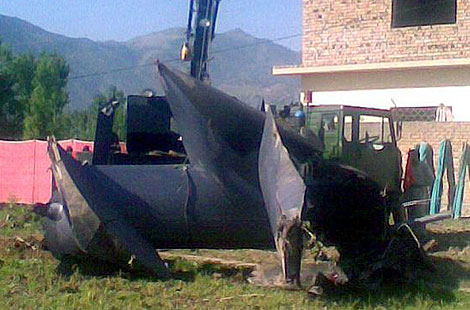
The destroyed helicopter's tail rotor sits near the compound where U.S. Navy SEALs killed Osama bin Laden.
WASHINGTON—The crash of a helicopter involved in the raid on Osama bin Laden's Pakistani hideout has prompted intense speculation about whether the aircraft was specially modified to fly stealthily—and whether its remains could offer hostile governments clues to sensitive U.S. military technology.
According to U.S. officials, two Black Hawk helicopters carrying Navy SEALs landed in the compound in Abbottabad, while two other helicopters circled overhead. One Black Hawk was disabled during the landing, and had to be destroyed by the commandos.
However, remnants of the helicopter, including a nearly intact piece of its tail, suggested that the aircraft involved in the raid wasn't the typical MH-60 Black Hawk flown by special-operations forces. Aviation experts who scrutinized photos of the scene say the tail had unusual features that suggested the helicopter had been extensively modified to fly quietly, while appearing less visible to radar.
WSJ's Julian Barnes profiles the Navy's Commando forces. The squads, such as the Navy SEALs force that stormed Osama bin Laden's compound, have been been increasingly used in Afghanistan. (Photo by John Moore/Getty Images)
The U.S. military has tried in the past to build a stealth helicopter, but has kept secret if it has indeed succeeded.
The wreckage in Abbottabad appeared to have exotic coatings and distinct surfaces and edges reminiscent of stealth aircraft such as the B-2 bomber and the F-22 fighter, aviation experts say. Equally important, they pointed to an unusual dishpan-shaped cover over the tail rotor, perhaps designed to make the aircraft quieter.
"The odds are fair—based on my knowledge of the subject area—the vast majority of the special MH-60s aircraft were purpose-built to make those aircraft as stealthy as they could possibly be," said Jay Miller, an author who has written extensively about stealth aircraft.
Mr. Miller said the remnants of the aircraft suggested extensive use of nonmetallic composite parts, which reflect less radar energy. Likewise, he said the tail's remains suggested that it was designed to shroud or mask metal parts, which are much more visible to radar.

After the Raid

While President Obama decided not to release photographs of Osama bin Laden's body, other photos taken at the compound were released by Reuters.

The Compound

Diagram from the U.S. government
Photos inside and out
Anjum Naveed/Associated Press
U.S. forces found Osama bin Laden at this compound in Abbottabad, Pakistan, about 40 miles outside Islamabad.
In addition, experts said the tail rotor's design suggested an effort to reduce the "acoustic signature" of the helicopters—in other words, to make them fly more quietly.
Rex Rivolo, a former Black Hawk aviator and helicopter expert, said the distinctive noise of a helicopter's rotor blades is "the signature that gives you away."
Mr. Rivolo said the military had studied a number of methods for reducing helicopter noise, including pairing helicopters with unmanned aircraft to cancel out noise.
But he was skeptical about how far those efforts had advanced.
"It's really never materialized," he said. " 'Whisper mode' just doesn't exist."
The U.S. Army spent billions developing the Comanche, a stealth-helicopter project canceled in 2004. Two prototypes were developed, but Comanches were never fielded because of their high price.
Stealth features would have been particularly important in the bin Laden mission: The Navy assault team presumably wanted to give those in the compound as little warning as possible.
In addition, the commandos entered Pakistani air space without permission of the Pakistani authorities; the longer it took for the Pakistani military to realize the helicopters were there, the less likely they would interfere in the U.S. mission.
The recovery of the tail by the Pakistanis raised questions about whether some of the unique technology may have fallen into the wrong hands.
Rep. Howard "Buck" McKeon (R., Calif.), the chairman of the House Armed Services Committee, told reporters Thursday he was unaware of any efforts to retrieve the tail. He said there wasn't much left of the aircraft after the SEALs blew it up, said a staffer who was present. The Pentagon declined to comment on the downed helicopter.

Black Helicopters What are they doing in Napa? By Harry V. Martin

From bottom of this article.

"EDITOR'S NOTE: Harry Martin was formerly the editorial director of Military Electronics Countermeasures, Defense Electronics, Microwave Systems News, International Countermeasures Handbook, and publisher of Defense Systems Review and Military Communications."


OK, that settles it, there are Black Helicopters. Now the question is, how did the Air Force lose so many of them to the CIA and the transnational drug runners? Hmmm?!


Black Helicopters

What are they doing in Napa?


By Harry V. Martin


Copyright FreeAmerica and Harry V. Martin, 1995


The United States Air Force has confirmed that those mysterious helicopter flights over Napa County are classified operations. The helicopters are supplying what appears to be a secret base located on Bureau of Land Management property, without the knowledge or permission of the Bureau. The U.S. military has not informed Napa County, nor has it indicated anything on FAA/Military maps.Aerial shots taken this weekend over the 87 acre Bureau land near Oakville Grade show large cement bunkers with large concrete doors, a new road, freshly graded, and some underground facility. The satellite link-ups have geo-synchronized microwave dishes pointing straight up. There are approximately 8 to 10 dishes on the tower, which is not shown on any FAA map.
The aerial shots would indicate that a lot of government money has gone into the building of this secret base in Napa. The structure is virtually near the top of a mountain. The military helicopter overflights are apparently supplying the underground facility.
The cargo helicopters, however, are only part of the traffic. Black helicopters without markings have been making 3 a.m. flights to the facility. There are several black helicopters at Hamilton Air Force Base, but all of them have some identifying marking, particular FBI markings. One helicopter only has a Playboy bunny marked on its tail.
The Air Force will not comment on the helicopters, only stating, "The helicopter traffic over the Napa Hills is a classified operation."
The Sentinel acknowledges the valuable assistance of Mike Jamieson for supplying films of the location.
But what type of military base is in the Napa hills and what is its function? That will be part of a series commencing on September 1, exclusive reports from within the military and intelligence community.

Black Helicopters

By Harry V. Martin

Copyright, Napa Sentinel 1992


A secret installation near the Oakville Grade is being used by the United States Government for three purposes. Increased helicopter traffic is directly linked to this installation.
The installations and helicopter traffic serve the following purposes:
Direct satellite communication.
Continuity of the U.S. Government in case of nuclear attack or other disasters.
Secure communication links with the outside world in the event of a disaster.
The helicopter traffic over the last year has been provisioning an elaborate underground complex designed to hold government officials, scientists and other high echelon personnel in the event of an emergency. The helicopters have been transporting generators, food stock, electronic and communications equipment, and other items to the site.The secret government site is replacing other installations and combining them into one solid underground center. An installation at Benicia is considered too marginal and vulnerable. Its functions have been transferred to Napa. An underground facility in Ukiah, an old railroad tunnel, was not serving the full purpose. The remote area of Napa was selected to combine the functions of the Ukiah and Benicia facilities into a more secure area. Napa is considered to be safe from the nuclear fallout zone of targeted areas in the San Francisco Bay Area.
The facility in the Napa hills is heavily fortified and protected with thick concrete. Its microwave tower is pointed toward Santa Rosa, where AT&T has secure communications links. The microwave dishes are to guarantee government officials with direct access to national communication links. The government has always relied on AT&T for those links.
The satellite dishes make direct communication with geosynchronized satellites at regular time intervals. The communication linkage is by laser, which accounts for the constant reports of light beams and flashes in the area. The operation in Napa County is classified according to the United States Air Force.
The area has been serviced by unmarked helicopters for some time. There have been other helicopter overflights, some as part of the Drug Enforcement Agency sweep and others are National Guard training missions. But the main and constant force has been to supply this secret installation.
The United States Government has similar installations all over the nation. These facilities are all located in remote areas which would not normally be targeted by enemy nations for a nuclear strike. Napa Valley's wine growing areas provide a good cover for such an installation.
Similar helicopter traffic has been reported in other areas of California and the west, which indicates the government is creating new facilities or is preparing for some type of disaster or upheaval.
The helicopters used in Napa are olive drab and also black, all unmarked. The olive drab helicopters originate from Hamilton Air Force Base and operate generally in late afternoon and in the evening. The black helicopters generally operate in the late evening and early morning hours. The olive drab helicopters are providing supplies to the secret installation, but the black helicopters are providing direct laser communication to satellites.
Hamilton Air Force base has confirmed that the helicopters originate from their area and that the mission is classified.
Black Helicopters

What they are doing in Napa

By Harry V. Martin


While KVON radio's news department and the "Johnny-come-lately" Napa Valley Register wallow in whether or not a telephone tower in Sonoma County has anything to do with the increased flight of helicopters in Napa County, the Sentinel has obtained over 200 pages of unclassified and secret documents which outline the purpose of a special communications and government continuity base in the Napa hills.
The documents, which focus on 26 unclassified reports, 1 "for official use" report, and 14 secret reports, relate specifically to continuity of government and emergency telecommunication systems. Participating with the government is this classified nationwide emergency telecommunications Service for National Security Telecommunications ITT, AT&T, COMSAT, MCII and TRT.
Plans went into motion in 1988 and 1989 to ensure secure national and international communications and the continuity of government in case of war or disaster. The plan is being implemented throughout the nation, with similar helicopter traffic and construction of facilities. For national security reasons, much of the work is done in secret.
The National Security Telecommunications Advisory Commission reactivated the Commercial Satellite Survivability Task Force to assist the government and recommending secure telecommunications systems that would survive any disaster. The systems are used not only in case of war, but also when disasters such as hurricanes, floods, or earthquakes destroy existing commercial telecommunication facilities.
The government asked the group for international augmentation from an interexchange carrier switch via an international gateway satellite earth station. The foreign end users identified in the report are senior U.S. civilian and military officials overseas. The problem that existed was that foreign satellites do not operate with the same type of equipment used in the United States. Satellite earth stations working together in an international link are owned and operated by different companies and agencies.
When the INTELSAT is used incompatibility is at a minimum, but when CCITT systems are used, there are major incompatibilities to be overcome. The construction of new systems is part of a 12-point plan:
That the Government establish a commercial satellite communications survivability program which will satisfy National Security requirements.
That the Government establish a Commercial Satellite Survivability (CSS) Program Office to coordinate the program within the Government.
That the CSS Program Office, in conjunction with the planning arm of the NCM, should undertake a program to develop emergency control plans and procedures to assure the capability to coordinate the restoration of commercial satellite communications service under emergency conditions.
The development of a capability for communications interoperability at critical earth stations to maintain emergency communications networks.
The development of a capability utilizing the Date Encryption Standard algorithm to protect critical digital communications links if communications protection over commercial satellite systems is required by the Government.
The development of a capability to enhance the survivability of satellite control systems through actions to achieve command link protection.
The development of control interoperability between satellite systems to control the commercial communications satellite assets under emergency conditions.
The development of capabilities which increase physical security of satellite control facilities and communications earth stations.
The CSS Program Office should initiate a study which would assess the susceptibility of existing commercial satellite communications systems to nuclear effects and provide recommendations which would established hardening guidelines for further commercial satellite programs.
Development of a transportable terminal capability to enhance survivability and restoral of critical satellite communications systems.
Enhancement of control survivability through the development of transportable TT&C terminal facilities.
Development of a capability for Ku-band communications interoperability at critical earth stations to maintain emergency communications networks.
Napa is not alone in this area in participation of the program, units exist through Pac Bell's access tandem in Vallejo and also in Benicia and Santa Rosa. These units can patch in or over disrupted communication ground lines. The main continental United States (CONUS) focuses on the west coast traveling to the east coast and back again. CONUS contour maps show a major segment of that critical beam is located on or near Napa.
On Tuesday, the Sentinel published an article outlining the purposes and scope of the local project and its relationship with the helicopter traffic. In summary, the article stated the purpose of a secret installation in Napa served by the helicopters was for:
Direct satellite communications.
Continuity of the U.S. Government in case of nuclear attack or other upheaval.
Secure communication links with the outside world in the event of a disaster.
The helicopter traffic over the last year has been provisioning an elaborate underground complex designed to hold government officials, scientists and other high echelon personnel in the event of an emergency, similar facilities are active all over the United States. The local installation is combining and replacing installations from Benicia to underground railroad tunnels in Ukiah.There is no sinister plot involved. The site was selected because Napa is considered to be safe from the nuclear fallout zone.

Black Helicopters, they do exist, despite local media scorn

Links with FEMA and Wackenhut Corporation

By Harry V. Martin

EDITOR'S NOTE: During the summer months, the Napa Sentinel published a series of articles on black helicopters and a clandestine government base operating in Napa County. Through nationwide radio programs and other contacts, the Sentinel has been able to accumulate substantial information to show that Napa was not exclusive in the helicopter-clandestine base scenario. Such activities have been reported all across the United States. This article concerns those other sightings.

They are black, unmarked and generally fly late at night. This is one type of helicopter traffic reported over Napa this year - regular and steady. Local air commanders have never confirmed the origins of these helicopters.
The local media, despite receiving reports of such activities themselves, have attempted to make a farce out of the numerous reports. The Napa Valley Register attempted to pooh-pooh the reports as from crazed UFO followers and used a PacBell repeating station photograph to "discredit" any clandestine base. KVON radio, which originally confirmed the helicopter flights, just recently qualified their previous reports by stating "if" such helicopters existed. Neither media has made any serious attempt to trace the origins or pattern of the helicopter traffic.
The Napa Sentinel reported the flight patterns, interviewed eyewitnesses, talked to military and intelligence sources, and provided a scenario for the entire phenomenon. Since that period of time, however, reports have surfaced across the country. Black helicopters overhead, unmarked. In a few ground sightings, the occupants of the helicopters have been described as men wearing black uniforms carrying automatic weapons. The helicopters appear almost unreachable.
In the Watsonville area, one such helicopter landed. Law enforcement officials went to investigate but left the scene when encountering armed men in black uniforms. "We had black helicopters come over here every day," states several Massachusetts families. "They were just plain black, with no markings."
A Paris, Texas-based group, "These mystery helicopters are almost always without identifying markings. The aircraft are frequently reported flying at abnormal, unsafe or illegal altitudes. They may shy away if witnesses or law officers try to approach. But there are several accounts of aggressive behavior on the part of the helicopter occupants."
These type of helicopters have also been reported over Loring, Maine, Wurtsmith, Michigan and Malmstrom, Montana, as well as northeastern New Mexico. Military officials in Colorado state that black helicopters seen in their area do not belong to the military. When the FAA was asked to investigate black helicopter traffic over New Mexico, Freedom of Information Act requests show they had no investigation on file. Yet, the FAA did have investigators in the field taking depositions from individuals.
Thomas Adams of Texas has spent a lot more time investigating the black helicopter mystery than the Sentinel has. He has listed hundreds of sightings from all over the country. In fact, the Napa Sentinel is not the only media to be investigating black helicopter traffic. Major TV and print media in Colorado, the Los Angeles Times, KLTV-TV in Tyler Texas, the Kilgore News Hearld in Texas, the Denver Post, the reports go on and on, in Colorado, Texas, Nebraska, Wyoming, Montana, Oklahoma, Kansas, Illinois, South Dakota, Arkansas, Alberta, Wisconsin, Berkeley, California, Missouri, Arizona, Minnesota. Law enforcement officials in various states have also investigated the black helicopter traffic.
The bulk of the helicopter traffic is seen throughout the United States from August through October, with some heavy activity in February, July, November and December. Reports have been received from Monterey and Southern California, as well. Colorado appears to have the heaviest concentration of black helicopter traffic, with Texas being second.
Communities and publications in these areas confirm or suggest the existence of underground facilities serviced by helicopters. "The small amount of published evidence that is available indicates that the great majority of these underground bases are for use by government agencies in the event of nuclear war," states one publication. The agencies associated with these underground facilities include the Pentagon, CIA, Federal Emergency Management Agency (FEMA) and the National Security Agency (NSA).
In May 1992, revelations came to the surface that a large secret government bunker was located under the rich Greenbriar Hotel in White Sulphur Springs, West Virginia. It had been hidden there for years. Only six members of Congress knew about the living quarters, meeting rooms and banks of computers and communications equipment installed underneath the posh hotel. It contains two giant blast doors, each weighing more than 20 tons, supplied with water, electricity and even a sewage treatment system. It also had an infirmary, shower facilities, a television studio, radio and communications equipment, phone booths and code machines, a dining and kitchen area, a power plant and even a crematorium for disposing of the corpses of those who might die inside the sealed bunker.
FEMA also operates a number of underground bunkers across the country. Such installations are usually surrounded by high fences and patrolled by armed guards. Only a few of the buildings appear above ground. At least 96 underground centers have been secretly funded by the United States Government.
A Chicago-based source with high credentials in such investigations, claims that the black helicopters are not a military operation, but rather are operated by the Wackenhut Corporation and FEMA. Wackenhut is a private company that provides security in prisons, hospitals, government installations and other facilities. It was founded by former FBI agents and has been called the modern "Robocop" organization. FEMA, has broad emergency powers. It was created by President Jimmy Carter and has the ability to virtually take over the country or any region in a disaster. With FEMA and the private Wackenhut army teamed together, neither are regulated by too many outside authorities.
Though the helicopter traffic over Napa eased after the series of media articles and broadcasts, they have reappeared again. In one eye-witnessed incident, at least four of the black helicopters focussed for hours on a site off of the Oakville Grade, northwest of the Fire Station near Dry Creek Road.
While Napa is in its infancy in investigating black helicopters (and some of the local media acting in infantile ways about the subject), the mysterious black helicopters are a well-talked about and well-written about phenomena in many other western states. Stay tuned.

EDITOR'S NOTE: Harry Martin was formerly the editorial director of Military Electronics Countermeasures, Defense Electronics, Microwave Systems News, International Countermeasures Handbook, and publisher of Defense Systems Review and Military Communications.


Friday, November 4, 2011

Secret Stealth Helicopters in Osama bin Laden Raid


A crashed non-existent extremely stealthy black helicopter. Non existent helicopter and non existent Tim Osman al-CIA-Qaeda leader who was buried at sea to prevent any identification of him since they got him already in 2001 at Tora Bora after 20 years plus work for the CIA and the Bush Oil and Drugs Cartel. Now repeat after me, there are NO black helicopters and al-CIA-Qaeda can leap over the Twin Trade Towers in a single bound. Yeah sure.

Based on the wreckage of one Blackhawk helicopter that was used in Bin Laden raid and destroyed with explosives by the Seals after it landed heavily at Bin Laden's compound and got damaged, many military analysts believe the aircraft involves hitherto unknown modifications to reduce its radar visibility and muffle noise.

According to one former air expert, the distinctive hard-angled shape of this destroyed Blackhawk didn’t look like a traditional Black Hawk but resembled the fuselage of the F-117 Stealth Fighter, which was created to deflect radar.

Because the U.S. didn’t warn Pakistan about the attack for fear of leak, the helicopters had to fly to the compound from their base in Afghanistan without being alerted by Pakistan’s military.

Experts also mentioned that a circular cover over the helicopter’s tail rotor could dampen noise to make people on the ground hardly recognize the helicopter’s arrival. Some people living near the area said they didn’t hear the helicopters until they were almost directly overhead. The rear end bears no resemblance to that of the Black Hawk typically used by the:

U.S. special forces


The rear end bears no resemblance to that of the Black hawk typically used by the U.S. special forces


An image of the UH-60 Black Hawk, a workhorse with U.S. forces including the Army, Navy and Airforce

An image of the UH-60 Black Hawk, a workhorse with U.S. forces including the Army, Navy and Airforce


In order to kill the Osama bin Laden, the military team arrived in two helicopters, that were officially descried as Blackhawks, the Sikorsky-made US military's workhorse helicopter for the past 30 years. The Pentagon now refuses to answer questions related to the Blackhawks used in the Bin Laden raid.


The rotor of the crashed “stealth” helicopter (left) from Sunday's raid and a close up of a standard UH-60 Black Hawk helicopter

The rotor of the crashed “stealth” helicopter (left) from Sunday's raid and a close up of a standard UH-60 Black Hawk helicopter


The aircraft has distinctive features including the smooth and angular outer shell, covered rotor blades and pointed rear end

The aircraft has distinctive features including the smooth and angular outer shell, covered rotor blades and pointed rear end


A writer for website Defense Tech suggested that the aircraft was a modified version of the MH-60 Black Hawk, which was manufactured by Sikorsky and first entered service with the U.S. army in 1979.

EzineSeeker.com

SEALs and other special forces have access to the latest military hardware, potentially explaining why they would have used an experimental or secret helicopter type


The helicopter is removed by Pakistan’s soldiers

The helicopter is removed by Pakistan’s soldiers


Experts also speculated that the classified helicopter could be a descendant of the now abandoned RAH-66 Comanche stealth helicopter project

Experts also speculated that the classified helicopter could be a descendant of the now abandoned RAH-66 Comanche stealth helicopter project


Tuesday, November 1, 2011

There are NO black helicopters. I repeat there are NO black helicopters.


Oh, those helicopters.

They don't exist.

 I repeat there are NO black helicopters.

Now you say it.

There are NO black helicopters.